Blockchain’s Next Leap: DAOs Reshaping Governance by 2027
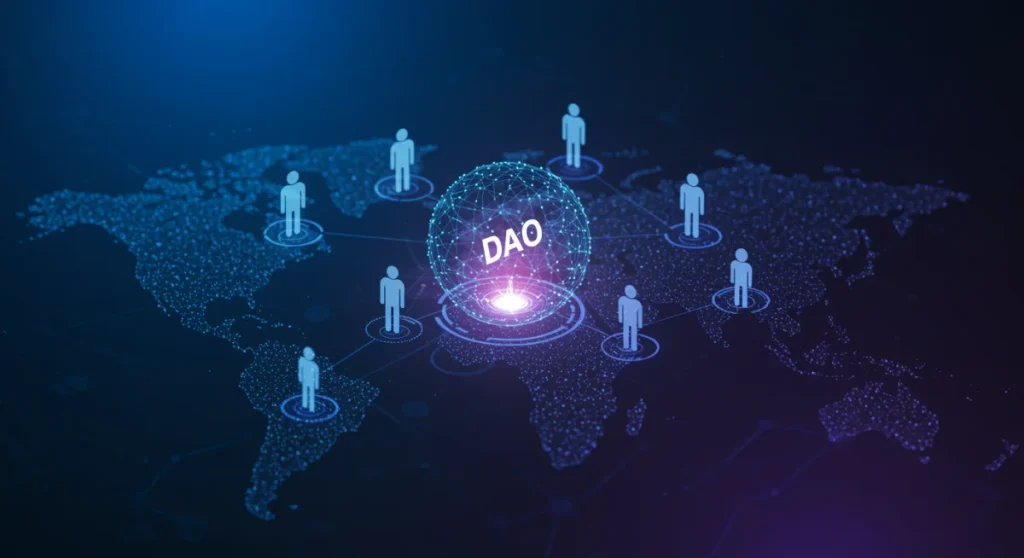
Decentralized Autonomous Organizations (DAOs) are poised to fundamentally reshape governance by 2027, leveraging blockchain technology to create transparent, community-driven decision-making frameworks that challenge traditional hierarchies.
The digital frontier is constantly evolving, and at its heart lies a transformative shift in how we organize and make decisions. DAOs Reshaping Governance is not just a theoretical concept for the distant future; it’s a present-day reality rapidly accelerating towards widespread adoption. By 2027, decentralized autonomous organizations (DAOs) are set to redefine what governance means, moving power from centralized entities to distributed communities. What does this mean for industries, societies, and our individual roles within them?
Understanding the DAO Phenomenon: Beyond the Hype
To truly grasp the impact of DAOs, we must move beyond the superficial buzz and delve into their fundamental mechanics. A Decentralized Autonomous Organization is essentially an organization represented by rules encoded as a computer program, transparent, controlled by the organization’s members, and not influenced by a central government. This radical departure from traditional corporate or governmental structures promises a new era of collective decision-making.
At its core, a DAO operates on a blockchain, utilizing smart contracts to automate processes and enforce rules. This ensures that once a decision is made by the community, it is executed without the need for intermediaries. The transparency offered by blockchain technology means every transaction and every vote is immutably recorded and publicly verifiable, fostering unprecedented trust among participants.
The Genesis of Decentralized Governance
The concept of decentralized governance didn’t emerge overnight; it’s a natural evolution stemming from the core principles of blockchain. Early cryptocurrency projects, particularly Bitcoin, demonstrated the power of a leaderless, distributed network. DAOs take this a step further, applying these principles to organizational management.
- Early Blockchain Innovations: Bitcoin laid the groundwork for secure, decentralized transactions.
- Ethereum’s Smart Contracts: The advent of Ethereum enabled programmable money and the creation of self-executing agreements.
- Community-Driven Development: Open-source projects have long showcased the efficacy of distributed contributions.
The transition from a purely technical innovation to a governance model signifies a maturation of blockchain technology, demonstrating its potential to reorganize human coordination at scale. This journey from simple digital cash to complex organizational structures highlights a continuous push towards greater autonomy and resistance to censorship.
How DAOs Function: A Technical Overview
DAOs operate through a combination of on-chain and off-chain mechanisms. On-chain governance involves direct voting on proposals recorded on the blockchain, while off-chain discussions and forums help shape these proposals. This hybrid approach allows for both efficient, automated execution and nuanced, human-driven deliberation.
The transparency and immutability of blockchain are key. Every member can see the organization’s treasury, proposals, and voting results. This inherent openness reduces the potential for corruption and increases accountability, shifting the paradigm of trust from individuals to the underlying code. In essence, the rules are public, and their execution is guaranteed.
The Economic Imperative: Why Businesses are Embracing DAOs
Beyond the philosophical appeal of decentralization, there’s a strong economic case driving the adoption of DAOs. Businesses are increasingly recognizing the inefficiencies and vulnerabilities inherent in traditional hierarchical structures. DAOs offer a compelling alternative, promising greater agility, resilience, and a more equitable distribution of value.
The cost savings associated with reduced bureaucracy and automated processes are significant. Furthermore, DAOs can tap into a global talent pool, incentivizing participation through native tokens and aligning the interests of all stakeholders. This model fosters a stronger sense of ownership and commitment among contributors, leading to more innovative and robust outcomes.
Enhanced Efficiency and Reduced Bureaucracy
Traditional organizations often grapple with layers of management, slow decision-making processes, and significant administrative overhead. DAOs, by contrast, streamline these operations through automated smart contracts and direct community voting. This eliminates many of the bottlenecks that plague conventional structures.
- Automated Operations: Smart contracts handle treasury management, proposal execution, and fund distribution.
- Direct Voting: Members vote directly on proposals, bypassing lengthy approval chains.
- Global Participation: Geographic barriers are removed, allowing for diverse contributions and perspectives.
The lean operational model of a DAO means resources can be allocated more directly to value-creating activities rather than administrative costs. This efficiency translates into faster development cycles and a quicker response to market changes, providing a competitive edge in rapidly evolving sectors.
Attracting and Retaining Talent in a Decentralized World
In today’s competitive landscape, attracting and retaining top talent is a major challenge for businesses. DAOs offer a unique value proposition: genuine ownership and influence. Contributors are often rewarded with governance tokens, giving them a direct stake in the organization’s success and a voice in its direction.
This sense of shared ownership and direct impact is a powerful motivator. Unlike traditional employment, where employees might feel like cogs in a machine, DAO contributors are integral to the organization’s very fabric. This fosters a highly engaged and dedicated community, leading to higher quality work and greater innovation.
Social Impact: DAOs as Catalysts for Fairer Societies
The implications of DAOs extend far beyond business and technology; they hold profound potential for social change. By democratizing access to decision-making and resource allocation, DAOs can empower marginalized communities, foster greater transparency in public services, and create more equitable systems of governance. The promise of a truly fair and inclusive society finds a powerful ally in decentralized structures.
Consider the potential for DAOs in charity, public good funding, or even local community management. Funds can be managed transparently, and decisions on how to allocate resources can be made directly by the affected community members. This removes intermediaries, reduces overhead, and ensures that resources are directed where they are most needed, increasing efficacy and trust.
Decentralizing Philanthropy and Public Goods
Traditional philanthropy often involves significant administrative costs and a lack of transparency regarding fund allocation. DAOs can revolutionize this sector by providing a direct, auditable pathway for donations and ensuring that funds are utilized according to the community’s collective will.
- Transparent Fund Management: All donations and expenditures are recorded on an immutable ledger.
- Community-Driven Funding Decisions: Donors and beneficiaries can collectively decide on project funding.
- Reduced Overhead: Automation minimizes administrative costs, maximizing impact.
The ability for anyone, anywhere, to contribute to and vote on public good initiatives creates a powerful new mechanism for collective action. This model can unlock significant capital for projects that might otherwise struggle to find traditional funding, fostering innovation and social progress on a global scale.

Empowering Local Communities
On a local level, DAOs can provide a framework for community self-governance. Residents could collectively manage local resources, fund community projects, or even develop local policies. This bottom-up approach to governance stands in stark contrast to top-down models, offering greater responsiveness to local needs and empowering citizens directly.
Imagine a neighborhood DAO where residents vote on park improvements, waste management strategies, or local event funding. This direct participation fosters a stronger sense of community ownership and responsibility, leading to more effective and sustainable local initiatives. The power to shape one’s immediate environment becomes a tangible reality through decentralized structures.
Navigating the Challenges: The Road Ahead for DAOs
While the promise of DAOs is immense, their path to widespread adoption is not without hurdles. Technical complexities, regulatory uncertainties, and the inherent challenges of human coordination in a decentralized setting all present significant obstacles. Addressing these issues will be crucial for DAOs to realize their full potential and truly reshape governance by 2027.
The evolving legal landscape is particularly critical. Governments worldwide are still grappling with how to classify and regulate DAOs, which don’t fit neatly into existing legal frameworks. Clearer regulations, coupled with ongoing technological advancements, will be necessary to build trust and enable mainstream adoption.
Technical and Scalability Hurdles
The underlying blockchain technology, while robust, still faces scalability challenges. As DAOs grow in membership and complexity, the volume of transactions and voting requires efficient and cost-effective solutions. Innovations in layer-2 scaling solutions and new consensus mechanisms are vital for overcoming these technical limitations.
- Blockchain Scalability: High transaction fees and slow processing times can hinder participation.
- Security Vulnerabilities: Smart contract bugs and governance attacks remain a concern.
- User Experience: Interacting with DAOs can still be complex for non-technical users.
The development of more user-friendly interfaces and robust security protocols will be key to lowering the barrier to entry and ensuring that DAOs are accessible to a broader audience. As the technology matures, these challenges are steadily being addressed by dedicated development communities.
Regulatory and Legal Ambiguities
One of the most significant challenges for DAOs is the lack of clear legal recognition and regulatory frameworks. Without defined legal status, DAOs face uncertainties regarding liability, taxation, and their ability to interact with traditional legal systems. This ambiguity can deter mainstream adoption and institutional participation.
Governments and legal bodies are slowly beginning to explore how to integrate DAOs into existing legal structures or create new ones. Jurisdictions like Wyoming have already taken steps to provide legal recognition for DAOs, signaling a growing understanding of their importance. The next few years will be critical in shaping the global regulatory landscape for decentralized organizations.
Case Studies: Real-World DAO Successes and Failures
Examining real-world examples provides invaluable insight into the practical application and evolution of DAOs. From innovative DeFi protocols to ambitious social experiments, the DAO landscape is rich with both inspiring successes and instructive failures. These case studies highlight the potential and the pitfalls, guiding the future development of decentralized governance models.
Projects like MakerDAO and Uniswap have demonstrated the power of DAOs in managing vast treasuries and governing complex financial protocols. Their ability to adapt and evolve through community consensus provides a blueprint for future decentralized applications. Conversely, early failures, such as ‘The DAO’ hack, served as crucial learning experiences, driving improvements in security and governance design.
Pioneering DAOs in Decentralized Finance (DeFi)
The DeFi sector has been a fertile ground for DAO experimentation. Protocols like Aave, Compound, and Curve Finance are entirely governed by their respective DAOs, with token holders voting on everything from interest rates to protocol upgrades. These DAOs manage billions of dollars in assets, proving the viability of decentralized financial governance.
- MakerDAO: Governs the DAI stablecoin, managing its collateral and stability fees.
- Uniswap: A decentralized exchange where token holders vote on protocol fees and treasury allocation.
- Compound: A lending protocol where the community determines interest rate models and supported assets.
The success of these DeFi DAOs underscores their ability to manage complex financial systems with transparency and efficiency, offering a glimpse into a future where financial institutions are entirely community-owned and governed.
Lessons from Early DAO Experiments
The history of DAOs is not without its dramatic learning moments. The infamous ‘The DAO’ hack in 2016, where a vulnerability led to the loss of millions of dollars, was a stark reminder of the nascent technology’s risks. However, this event catalyzed significant advancements in smart contract security audits and better governance frameworks.
These early experiences taught the community the importance of robust code, thorough testing, and flexible governance mechanisms that can respond to unexpected events. The evolution from these initial challenges to today’s more sophisticated DAO structures demonstrates a continuous learning curve and a commitment to building more resilient decentralized systems.
The Future is Decentralized: Predictions for 2027
Looking ahead to 2027, the trajectory for DAOs points towards significant integration into various aspects of our lives. We can anticipate DAOs moving beyond the crypto native space and permeating traditional industries, from media and entertainment to scientific research and urban planning. The concept of collective ownership and transparent governance will become increasingly mainstream, challenging existing power structures.
Predicting the exact shape of this future is challenging, but the underlying trends are clear. As blockchain technology matures and regulatory clarity emerges, DAOs will offer compelling alternatives for organizing human endeavor, fostering innovation, and building more inclusive systems. The shift towards decentralized governance is not just an incremental change but a fundamental paradigm shift.
Mainstream Adoption and Interoperability
By 2027, expect to see DAOs becoming more user-friendly and interoperable with existing web2 applications and traditional legal entities. This will facilitate easier participation for non-technical users and enable DAOs to interact seamlessly with the broader economy. The integration of identity solutions and clearer legal frameworks will accelerate this trend.
- User-Friendly Interfaces: Simplified tools for proposal creation and voting.
- Cross-Chain Functionality: DAOs operating across multiple blockchain networks.
- Legal Recognition: Clearer legal status enabling easier interaction with traditional systems.
The focus will shift from purely technical innovation to creating accessible and legally viable structures that can scale to meet the demands of a global, decentralized economy. This mainstreaming will be pivotal in DAOs fulfilling their promise of reshaping governance.
DAOs in Traditional Industries
The influence of DAOs will extend into sectors traditionally dominated by centralized corporations. Imagine media organizations where content creators and consumers collectively govern editorial decisions, or scientific research groups where funding and research directions are determined by a global community of experts. The possibilities are vast.
This integration will not necessarily mean the complete overthrow of existing structures but rather a hybrid model where DAOs coexist and collaborate with traditional entities. The principles of transparency, community ownership, and automated governance will inject new life and efficiency into industries ripe for disruption, fostering a more collaborative and equitable economic landscape.
Empowering the Individual: Your Role in the DAO Revolution
The rise of DAOs isn’t just about technological shifts; it’s about a fundamental redefinition of individual agency and collective power. In a world increasingly shaped by decentralized autonomous organizations, individuals are no longer passive consumers or employees but active participants with a direct stake in governance. Understanding your role in this revolution is crucial for navigating the future landscape.
Whether it’s through contributing to a project, voting on proposals, or even initiating your own DAO, the opportunities for engagement are expanding. This shift empowers individuals to align their efforts with projects and communities that reflect their values, fostering a more meaningful and impactful form of participation in the digital economy.
From Consumer to Co-Owner: A Paradigm Shift
The traditional consumer-producer relationship is being challenged by DAOs. In many decentralized ecosystems, users are also owners, holding tokens that grant them both economic rights and governance power. This transforms passive consumption into active co-ownership, aligning incentives and fostering a deeper connection to the products and services they use.
- Direct Influence: Token holders can vote on product features, development roadmaps, and treasury allocation.
- Shared Success: Economic rewards are distributed to contributors and owners.
- Community Building: Stronger bonds form between users who share ownership and governance responsibilities.
This paradigm shift not only democratizes access to economic opportunities but also creates a more resilient and responsive ecosystem, where the collective intelligence of the community drives innovation and ensures long-term sustainability. Your voice truly matters in a DAO.
Getting Involved: Pathways to Participation
For those eager to participate in the DAO revolution, there are numerous avenues. Start by researching projects that align with your interests and values. Many DAOs have active communities on platforms like Discord or Telegram, where you can learn, ask questions, and begin contributing. Acquiring governance tokens is often the first step towards active participation.
Even without significant technical expertise, individuals can contribute through content creation, community management, strategic advice, or simply by spreading awareness. The decentralized nature of DAOs means there’s a role for everyone, regardless of their background. The future of governance is being built by communities, and you have the opportunity to be a part of it.
| Key Aspect | Impact on Governance by 2027 |
|---|---|
| Decentralization | Shifts power from central authorities to distributed communities, fostering greater autonomy. |
| Transparency | Blockchain ensures all decisions and transactions are publicly verifiable and immutable. |
| Efficiency | Automated smart contracts reduce bureaucracy and accelerate decision-making processes. |
| Community Empowerment | Individuals gain direct ownership and influence over organizational direction and resources. |
Frequently Asked Questions About DAOs and Governance
A DAO is an organization governed by rules encoded in smart contracts on a blockchain. It operates autonomously, with decisions made by its members through voting, eliminating the need for central authority. This structure ensures transparency and resistance to censorship, fundamentally changing how entities can be managed.
Traditional companies have hierarchical structures with centralized leadership, while DAOs are flat, transparent, and community-governed. Decisions in DAOs are made through collective voting by token holders, and operations are automated via smart contracts, drastically reducing bureaucracy and fostering direct participation.
Key benefits include enhanced transparency, as all actions are recorded on a public ledger, and increased efficiency through automated processes. DAOs also foster greater inclusivity by allowing global participation and empowering individual members with direct voting power, leading to more equitable outcomes.
DAOs face significant challenges, including technical scalability issues, security vulnerabilities in smart contracts, and a lack of clear regulatory frameworks. User experience also needs improvement to attract non-technical users, and establishing robust, adaptable governance models remains a complex endeavor for many.
Individuals can participate by acquiring governance tokens of a DAO, which grant voting rights on proposals. They can also contribute to the community through discussions, content creation, or by proposing new initiatives. Many DAOs welcome diverse skill sets, offering various entry points for engagement and influence.
Conclusion
The journey towards a future where DAOs Reshaping Governance is not merely a possibility but an inevitable trajectory. By 2027, the foundational principles of decentralization, transparency, and community empowerment embedded within Decentralized Autonomous Organizations will have profoundly altered how we perceive and practice governance across various sectors. While challenges persist, the rapid pace of technological innovation and increasing regulatory clarity suggest a robust future for DAOs. Their ability to foster efficiency, reduce bureaucracy, and redistribute power promises a more equitable, resilient, and inclusive world. Engaging with this transformative technology today is not just about staying ahead of the curve; it’s about actively participating in the creation of a more democratic digital future.