Automation Impact: 4 US Industries Facing 20% Job Transformation by 2026

By 2026, automation is projected to transform 20% of jobs across four major US industries, necessitating proactive adaptation strategies for both workers and companies.
The Automation Impact: An Analysis of 4 Key US Industries Facing 20% Job Transformation by 2026 and How to Adapt is no longer a distant future scenario but a present reality reshaping our economic landscape. As technology rapidly advances, understanding its implications for the workforce becomes paramount for individuals and organizations alike.
Understanding the Automation Wave and its Economic Significance
The current wave of automation, powered by artificial intelligence, machine learning, and advanced robotics, is fundamentally altering how work is done across various sectors. This isn’t merely about replacing manual labor; it’s about redefining tasks, creating new roles, and demanding a significant shift in skill sets. The economic significance of this transformation is immense, influencing productivity, competitiveness, and the very structure of employment.
For the US economy, this shift presents both substantial opportunities and considerable challenges. Industries that embrace automation effectively can achieve unprecedented levels of efficiency and innovation. However, those slow to adapt risk falling behind, potentially leading to widespread job displacement if not managed thoughtfully. The discussion around automation often focuses on job losses, but it’s equally important to highlight the creation of new, often higher-skilled, positions and the enhancement of existing ones.
The Dual Nature of Automation: Disruption and Opportunity
Automation’s impact is rarely a simple one-to-one replacement. Instead, it frequently augments human capabilities, allowing workers to focus on more complex, creative, and strategic tasks. This augmentation can lead to significant boosts in productivity and job satisfaction, provided workers receive the necessary training and support.
- Increased Productivity: Automated systems can perform repetitive tasks faster and more accurately than humans.
- New Job Creation: Demand for AI specialists, robotics engineers, and data scientists is surging.
- Enhanced Safety: Robots can handle dangerous tasks, reducing workplace injuries.
- Economic Growth: Increased efficiency and innovation can drive overall economic expansion.
Ultimately, navigating this automation wave requires a nuanced understanding of its mechanisms and a strategic approach to workforce development. The goal is not to resist automation but to harness its power while ensuring a just transition for the workforce.
Manufacturing: Rebuilding the Workforce for an Automated Future
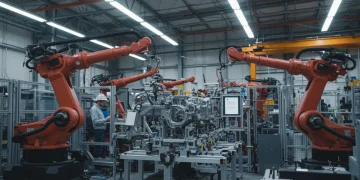
The manufacturing sector has historically been at the forefront of automation adoption, from assembly line mechanization to modern robotics. By 2026, projections suggest that up to 20% of manufacturing jobs could undergo significant transformation due to advanced robotics, AI-driven quality control, and predictive maintenance systems. This transformation isn’t just about robots on the factory floor; it’s about integrating smart factories, supply chain automation, and data analytics into every aspect of production.
This shift necessitates a workforce equipped with different skills. Manual labor roles may decrease, but demand for technicians who can program, maintain, and troubleshoot complex automated systems will soar. Furthermore, roles focused on data analysis, cybersecurity for industrial control systems, and human-robot collaboration will become increasingly critical.
Key Areas of Transformation in Manufacturing
The integration of Industry 4.0 technologies means factories are becoming more interconnected and intelligent. This extends beyond production to logistics, inventory management, and even customer service in some cases.
- Robotics and Advanced Automation: Replacing repetitive tasks while creating roles for robot operators and maintenance specialists.
- AI-Powered Quality Control: Algorithms detecting defects with greater precision, requiring human oversight and analytical skills.
- Predictive Maintenance: AI analyzing machine data to anticipate failures, leading to new roles for data analysts and specialized technicians.
- Supply Chain Optimization: Automation streamlining logistics, demanding expertise in digital supply chain management.
Adapting to this future means significant investment in reskilling and upskilling programs. Manufacturers, educational institutions, and government bodies must collaborate to create pathways for workers to acquire the necessary technical and soft skills to thrive in this evolving environment. The goal is to build a resilient manufacturing workforce capable of leveraging technology for sustained growth.
Retail and E-commerce: Navigating Automated Customer Experiences and Logistics
The retail and e-commerce sectors are experiencing a profound transformation driven by automation. From automated warehouses to AI-powered customer service chatbots and personalized shopping experiences, technology is reshaping how consumers interact with brands and how goods are delivered. By 2026, a substantial portion of roles, particularly in logistics, inventory management, and customer support, could see significant changes, potentially affecting up to 20% of the workforce in these areas.
The rise of e-commerce has accelerated the need for efficient, automated fulfillment centers where robots handle picking, packing, and sorting. This reduces the number of purely manual roles but increases the demand for specialists in automation maintenance, data analytics for logistics optimization, and software development for e-commerce platforms. In customer service, AI chatbots are handling routine inquiries, allowing human agents to focus on more complex and empathetic interactions.
Innovations Driving Retail Automation
Retailers are leveraging automation to enhance the customer journey and streamline back-end operations. This includes everything from smart inventory systems to personalized marketing algorithms.
- Automated Warehouses: Robots manage inventory and fulfillment, reducing manual labor but increasing demand for technical oversight.
- AI-Powered Customer Service: Chatbots handle routine queries, freeing human agents for complex problem-solving.
- Personalized Marketing: Algorithms analyze customer data to deliver tailored shopping experiences.
- Last-Mile Delivery Automation: Drones and autonomous vehicles are emerging, impacting delivery driver roles.
For workers in retail and e-commerce, adaptability is key. Training in digital literacy, data interpretation, and advanced customer relationship management will be crucial. The focus will shift from transactional interactions to building deeper customer relationships and managing advanced technological systems.
Transportation and Logistics: The Autonomous Revolution on the Horizon
The transportation and logistics sector is on the cusp of an autonomous revolution. Self-driving trucks, automated port operations, and drone delivery systems are no longer science fiction; they are rapidly becoming viable technologies. This sector, vital to the US economy, is projected to see significant job transformation by 2026, with potentially 20% of roles impacted as autonomous systems become more prevalent.
While the image of driverless trucks sparks concerns about job displacement for professional drivers, the reality is more complex. The transition will likely be gradual, with human oversight still required for many years. New roles will emerge in the development, maintenance, and remote operation of autonomous vehicles. Furthermore, the increased efficiency of automated logistics could lead to growth in other areas, such as specialized cargo handling and data management for optimized routes.
Transformative Technologies in Transportation
The integration of AI and robotics is not just about vehicles; it’s about optimizing entire networks, from traffic management to supply chain resilience.
- Autonomous Vehicles: Reshaping trucking and delivery, creating demand for remote operators and maintenance technicians.
- Automated Port Operations: Cranes and transporters run autonomously, requiring skilled technicians and system supervisors.
- Drone Delivery: Revolutionizing last-mile logistics, creating roles in drone operation and maintenance.
- AI-Driven Route Optimization: Enhancing efficiency and reducing fuel consumption, requiring data analysis skills.
The workforce in transportation and logistics will need to adapt by acquiring skills in areas such as telemetry, sensor technology, cybersecurity for autonomous systems, and advanced data analytics. Government policies and industry initiatives will be critical in supporting this transition, ensuring that workers are prepared for the jobs of tomorrow.
Healthcare: AI and Robotics Enhancing Patient Care and Operations
The healthcare sector, traditionally perceived as highly human-centric, is increasingly integrating automation, AI, and robotics to enhance patient care, streamline operations, and improve diagnostic accuracy. By 2026, approximately 20% of healthcare jobs, particularly in administrative tasks, diagnostics, and surgical assistance, are anticipated to undergo significant transformation. This shift is not about replacing healthcare professionals but augmenting their capabilities and allowing them to focus more on direct patient interaction and complex medical decisions.
AI is revolutionizing diagnostics by analyzing medical images and patient data with incredible precision, assisting doctors in identifying diseases earlier. Robotic surgical assistants enhance precision and reduce recovery times. Automated systems are also taking over repetitive administrative tasks, such as scheduling and billing, freeing up staff for more critical duties. This evolution requires healthcare professionals to become proficient in using these new technologies and interpreting their outputs.
Impact Areas of Automation in Healthcare
The integration of technology in healthcare spans across various functions, from the front office to the operating room and beyond.
- AI in Diagnostics: Assisting radiologists and pathologists with faster, more accurate disease detection.
- Robotic-Assisted Surgery: Enhancing precision and minimizing invasiveness, requiring specialized training for surgeons and support staff.
- Automated Administrative Tasks: Streamlining patient registration, scheduling, and billing, freeing human staff for direct patient care.
- Telemedicine and Remote Monitoring: Leveraging AI to provide virtual care and track patient health, creating new roles in digital health management.
Healthcare workers will need to develop digital literacy, data interpretation skills, and an understanding of AI ethics in medicine. Medical education must evolve to incorporate these technological advancements, preparing future professionals for a more technologically integrated healthcare environment.
Strategies for Adaptation: Empowering the Future Workforce
The transformation across these four key US industries—manufacturing, retail/e-commerce, transportation/logistics, and healthcare—underscores the urgent need for comprehensive adaptation strategies. With 20% of jobs facing significant changes by 2026 due to automation, a multi-faceted approach involving individuals, businesses, educational institutions, and government is essential to empower the future workforce.
For individuals, embracing lifelong learning and developing a growth mindset are paramount. The ability to acquire new skills, adapt to evolving technologies, and understand data will be critical. Businesses must invest in their employees through robust reskilling and upskilling programs, fostering a culture of continuous learning. This not only prepares their workforce for new roles but also enhances employee loyalty and retention.
Key Pillars of Workforce Adaptation
Successful adaptation will hinge on proactive measures and strategic collaborations between various stakeholders.
- Continuous Learning and Reskilling: Individuals must actively seek out opportunities to learn new skills relevant to automated environments.
- Employer-Led Training Initiatives: Companies should invest in internal programs and partnerships with educational providers.
- Educational Reform: Curricula from K-12 through higher education must evolve to teach digital literacy, critical thinking, and STEM skills.
- Government Support and Policy: Policies supporting vocational training, unemployment benefits during transition, and incentives for business investment in workforce development.
Ultimately, a collaborative ecosystem where education, industry, and government work in concert will be crucial for navigating the challenges and harnessing the opportunities presented by automation. The goal is to ensure that the US workforce remains competitive, innovative, and resilient in the face of technological change.
| Key Industry | Impact and Adaptation |
|---|---|
| Manufacturing | Robotics and AI transform 20% of jobs; demand for technicians and data analysts increases. |
| Retail & E-commerce | Automated logistics and AI customer service; new roles in digital literacy and data interpretation. |
| Transportation & Logistics | Autonomous vehicles and drone delivery; need for remote operators and system maintenance. |
| Healthcare | AI diagnostics and robotic surgery; requiring digital literacy and AI ethics understanding. |
Frequently Asked Questions About Automation’s Impact
By 2026, the manufacturing, retail and e-commerce, transportation and logistics, and healthcare sectors are projected to experience the most significant job transformation due to automation, with up to 20% of roles being impacted. These industries are rapidly adopting AI, robotics, and advanced digital systems.
While some jobs may be displaced, automation is also creating new roles and augmenting existing ones. The focus shifts from repetitive tasks to positions requiring skills in AI maintenance, data analysis, human-robot collaboration, and strategic oversight. Adaptation through reskilling is crucial.
Essential skills include digital literacy, data interpretation, critical thinking, problem-solving, creativity, and adaptability. Technical skills in AI, robotics, and cybersecurity will also be highly valued. Lifelong learning and continuous upskilling are key to remaining relevant.
Businesses should invest in robust reskilling and upskilling programs, offer internal training, and partner with educational institutions. Fostering a culture of continuous learning and providing clear career pathways for employees in automated environments will be vital for successful transition.
Government plays a crucial role in providing support for vocational training, unemployment benefits during transitions, and incentives for businesses to invest in workforce development. Policy also shapes educational reforms to align curricula with future job market demands, ensuring a prepared workforce.
Conclusion
The projected 20% job transformation across four key US industries by 2026 due to automation is a powerful indicator of the profound shifts underway. While the scale of this change might seem daunting, it also presents an unparalleled opportunity for growth, innovation, and the creation of more engaging, high-value roles. Embracing this future requires a proactive and collaborative effort from individuals, businesses, educational institutions, and government. By investing in continuous learning, fostering adaptability, and strategically guiding workforce development, the United States can navigate the automation impact successfully, ensuring a resilient and prosperous future for its industries and its people.